Repeat.gg is winding down, and the date that actually matters to you is November 14, 2026, the day withdrawals close. Anything still sitting in your Repeat balance after that is gone. So the order of operations is: get your money out first, pick where you're playing next second. This piece covers both, including where Gamercraft works as a Repeat.gg alternative and where it doesn't.
What is happening to Repeat.gg?
Repeat announced in April 2026 that it was shutting the platform down after more than a decade of running tournaments, citing a shift in priorities and long-term focus. Tournaments wrapped up in June. The site is now in a wind-down period: deposits are switched off, no new tournaments are being added, and login access is being kept alive mainly so people can empty their accounts.
Sony had picked Repeat up in 2022 during PlayStation's push into competitive gaming. That era's over. For the couple of million people who used the site, the practical question isn't corporate strategy. It's whether the balance still shows up when you log in.
How do I get my money out of Repeat.gg?
Log in and withdraw before November 14, 2026. Repeat has made this deliberately easier than it used to be, and the changes matter because they mean small balances are now worth claiming:
The $20 minimum balance requirement for withdrawals has been removed.
Account verification is no longer required before you can withdraw.
The coin redemption threshold dropped to 70,000 coins, down from roughly 90,000.
Coins from separate accounts can't be pooled to reach that threshold.
If you wrote off a $4 balance two years ago because it sat under the old minimum, that $4 is claimable now. Repeat's own shutdown FAQ is the authoritative source on all of this, and it's the page to check if your situation is unusual. Do that part before you read the rest of this.
What should you look for in a Repeat.gg alternative?
Repeat's appeal was specific. You played your own ranked games, your stats got scored, and good performance paid out. You weren't scheduling around a bracket or rounding up four friends on a Tuesday night. Any replacement that makes you show up at 8pm for a single-elimination ladder is solving a different problem than the one you had.
So the questions worth asking are narrow. Does it score the games you already play, or does it want you to enter something separate? What does it cost to get your money out, and how long does that take? And is the scoring transparent enough that you can tell why you placed where you placed?
That last one is where most platforms go vague, so it's the one worth pushing on.
How does Gamercraft compare on payouts?
Fair warning: we run Gamercraft, so read this section as a spec sheet rather than a recommendation. These are the numbers as they stand in August 2026.
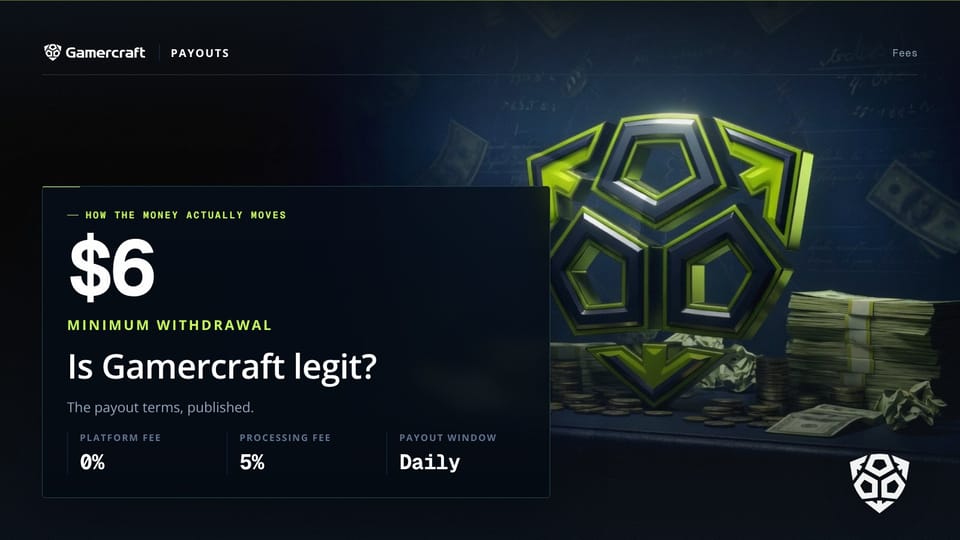
Gamercraft's minimum withdrawal is $6.00, and it's the same figure whether or not you're a subscriber. Gamercraft charges no withdrawal fee on either account type. Payouts run through Trolley. You can also convert credits in the Gamercraft store instead of withdrawing, which some players prefer for smaller amounts.
Which games can you actually play for money?
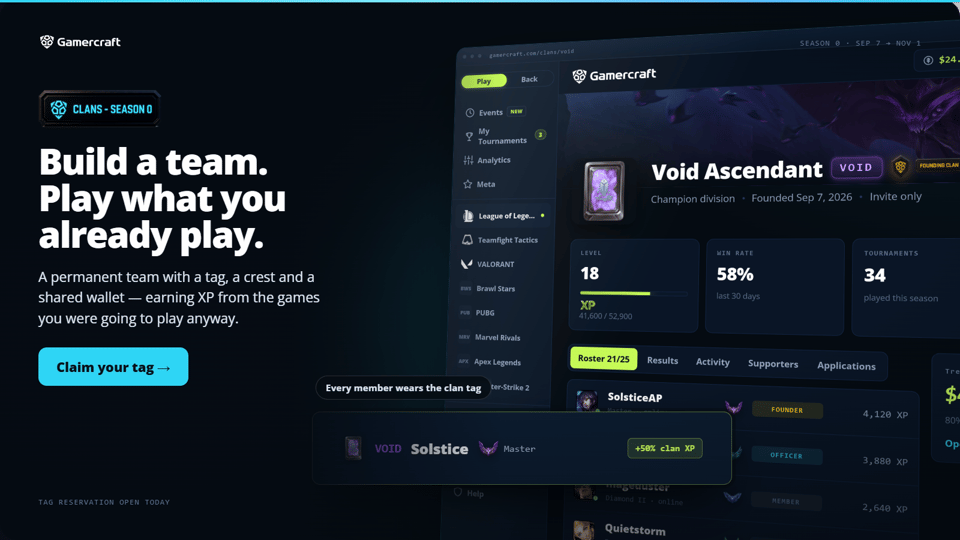
Gamercraft runs four games today: League of Legends, Valorant, Teamfight Tactics and Brawl Stars. Marvel Rivals, Apex Legends and Counter-Strike 2 are listed as coming soon rather than live, so don't switch platforms on the strength of those three.
The format sits closer to Repeat's than to a traditional bracket. You join a ladder, play your own ranked games, and your performance in those games is what gets scored. Gamercraft also runs freeroll tournaments with free entry, a no-cost way to see whether the scoring feels fair before you put real money behind it -- the same free-entry format Repeat.gg players are already used to.
What does Gamercraft do differently?
The real differentiator is the scoring, not the prize pool. Gamercraft scores every match with a Gamercraft Competitive Score, and the scoring model is built per game rather than bolted on top of one generic formula.
Teamfight Tactics is scored out of 20 and is placement-driven, so where you finish carries most of the weight, with smaller contributions from level and damage. Valorant is scored out of 100 and is relative: your performance is measured against the best other player in your lobby rather than against a fixed benchmark. That distinction does real work. A 20-kill game in a lobby full of iron players and a 20-kill game against immortals are not the same game, and a flat stat line can't tell them apart.
League of Legends runs its own scoring track, with Summoner's Rift and ARAM scored by different engines rather than lumped together. Gamercraft rebuilt the League profile around the score in August 2026, so the match panels, the ARAM tier list and the champion breakdowns now lead with the score instead of raw KDA. There's more detail in the August product update if you want it.
One thing Repeat didn't do: you can stack multiple entries from the same queue and have one set of games score against all of them, up to a ceiling of 12. A good night compounds instead of counting once.
Should you switch before November 14?
Those are two separate decisions, and only one of them has a deadline.
Withdrawing from Repeat has a hard cutoff of November 14, 2026, and there's no argument for missing it. Picking a new platform doesn't, and if you're weighing options, the free-entry freeroll tier exists precisely so you don't have to take a marketing page's word for how the scoring behaves.
Play a few games, look at how the score broke down, and decide from that. It's a better basis than any comparison table, this one included.


 Thomas RuizSeptember 19 min