You no longer have to pick one tournament and hope it was the right one. The Gamercraft tournaments page now lets you stack up to 12 entries from the same queue and score all of them with a single set of games. That is the biggest of this month's Gamercraft product updates, but it is not the only one: the League profile got rebuilt around the score too, and Teamfight Tactics and Valorant both have full analytics profiles now, each with a laser-focus on the GCS (Gamercraft Competitive Score) to help you understand your performance.
Stack up to 12 entries and play them all at once

On the tournaments page, hitting Select turns the tournament cards into a picker. You choose the entry tiers you want, they collect in a docked bar at the bottom of the screen with a running total, and one confirmation joins all of them.
The feature explains itself in four words: play once, count everywhere. One set of games scores every tournament in your stack, so a $2, a $5 and a $10 entry in the same queue are all settled from the same matches.
The catch is the queue. Your first pick locks it, and every entry after that has to share it. This makes the in-app version narrower than the phrase might suggest. Our earlier tournament stacking strategy piece described stacking across different games and formats, and the shipped feature is stricter than that, because scoring one set of matches into several tournaments only works when those tournaments are asking for the same matches.
Some tournaments never join a stack at all. Team ladders have their own join flow, and anything that needs an access code still has to be entered by hand.
When a card cannot be added, it tells you why instead of just going grey. The card itself shows "Tier limit reached", "Different queue", "Needs a ticket" or "Needs access code".
The confirmation screen lists the total entry cost, your wallet balance and what that balance will be afterwards. If you are short, it says by how much rather than failing at the end. If part of the stack fails during the join you get a straight answer, along the lines of "Joined 3 of 5", and if none of them go through, nothing is charged.
LoL analytics: the profile rebuilt around the score
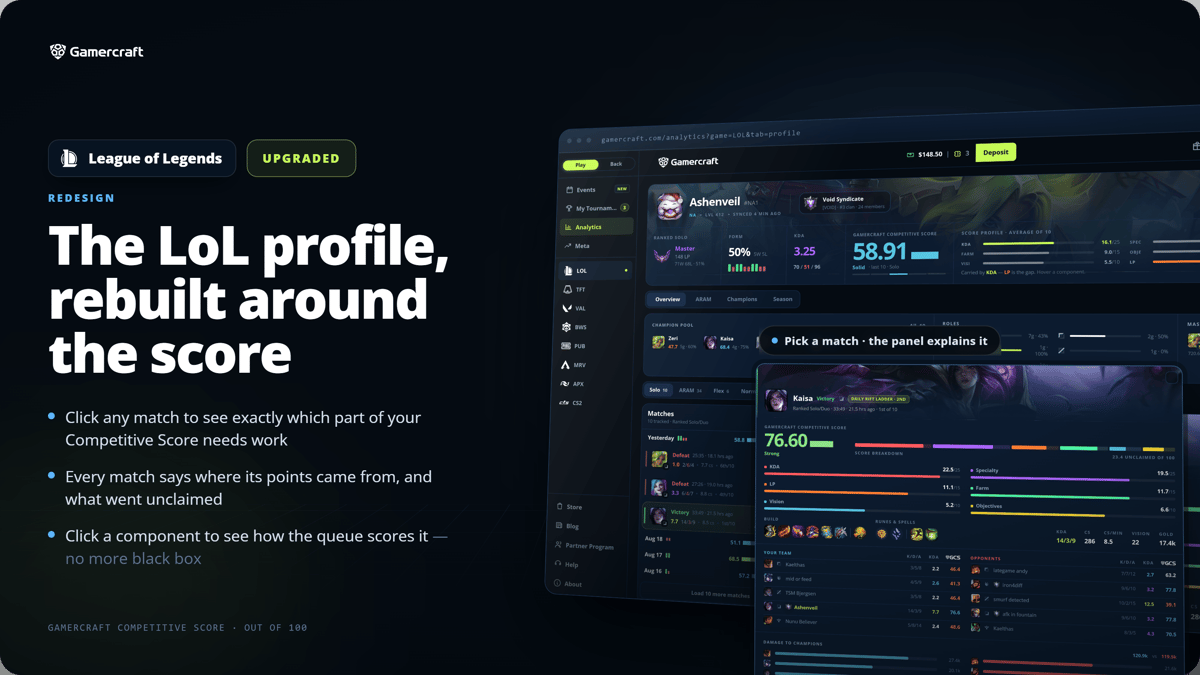
The League profile's three tabs, Overview, ARAM and Champions, got rebuilt around the Gamercraft Score instead of around raw stats. The old Insights tab is gone, along with the scoring-version labels like V4.2.0 that used to sit in the header.
The Overview hero banner puts your rank, recent form and KDA next to your GCS, with a six-bar equaliser underneath that breaks the score down instead of just stating it. Match rows are single-line now: score, KDA, CS per minute and LP, all in one row with no wrapping, so scanning ten games for the one that tanked your rank takes a glance instead of ten clicks.
ARAM's tab gets the same treatment: a redesigned tier list plus four signals, team fight, poke and sustain, death timer and gold efficiency, each shown as an icon and a bar that reveals its exact impact on hover.
The Champions tab pairs a hero panel (your best champion's score, games, win rate, KDA and CS) with a bar that breaks that score into its parts, and a pool table below where each champion's GCS now shows as an actual mark instead of a colored header.
TFT analytics: a score out of 20, and most of it is placement
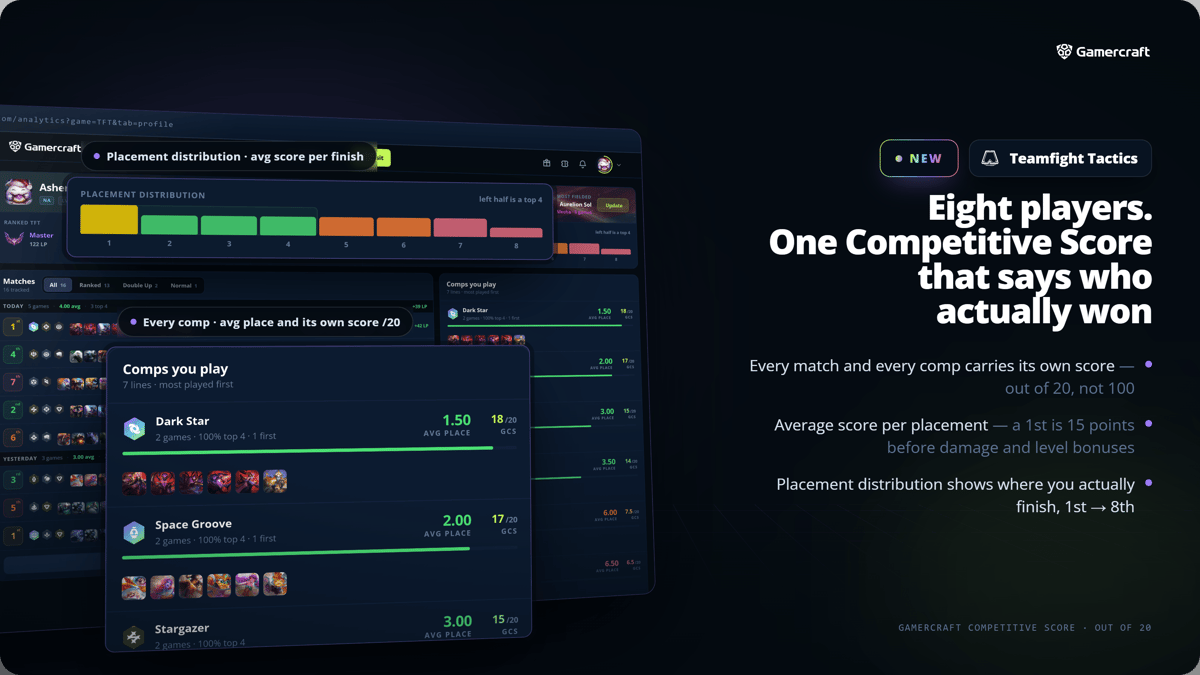
The TFT profile leads with your ranked tier and LP, your recent placements as a form strip, your average placement, your top-four rate and your number of firsts. Under that sits a distribution chart of how often you land in each of the eight slots, which tells you something an average cannot: whether you are a reliable fourth or a coin flip between first and eighth.
The Gamercraft Score for TFT is out of 20, and it is mostly a placement score. Up to 15 points come from where you finish, up to 3 from your level and up to 2 from damage dealt to other players. That weighting follows the same principle as the rebuild we wrote up when the TFT scoring system moved to rewarding consistent placement over chasing firsts.
The profile also names the unit you field most often, with its cost tier and the number of games you have played it in.
Valorant analytics: a score out of 100, measured against your lobby
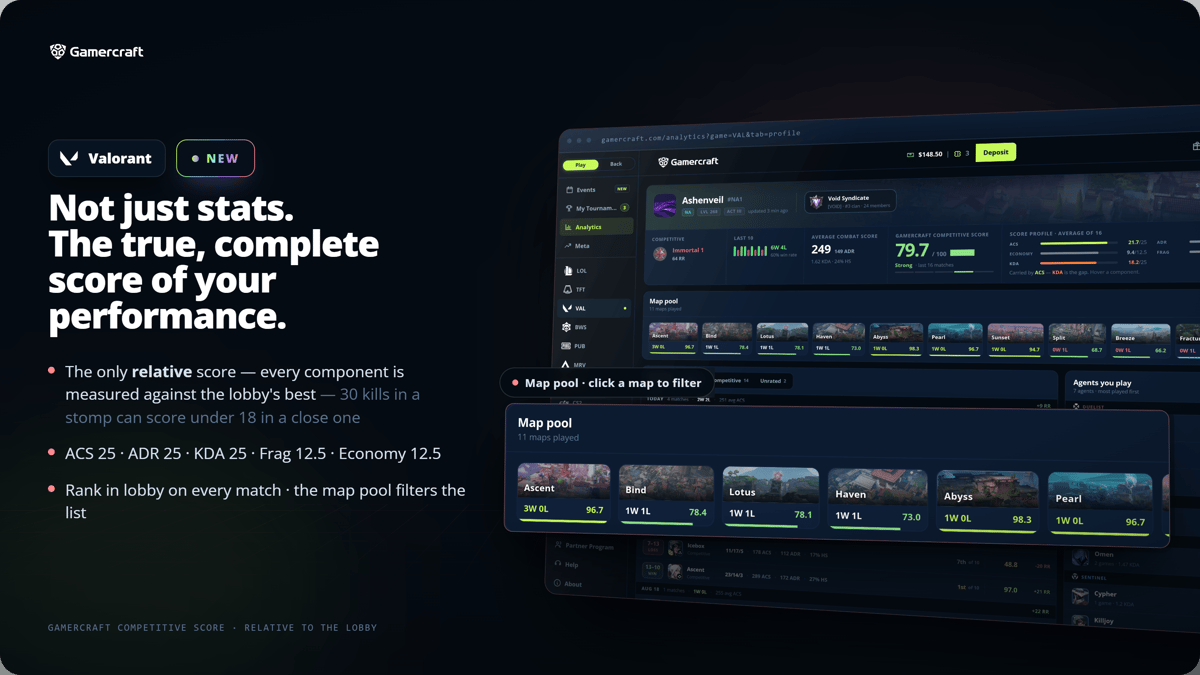
Valorant scores differently, and the difference is the interesting part. Your score is relative. Every component is measured against the best other player in that lobby rather than against a fixed target.
The total is out of 100 across five components. KDA, average combat score and average damage rating are worth 25 points each. Frag rating and economy rating are worth 12.5 each.
Because the model is relative, each component is shown with its rank in the lobby next to it. That matters more than it sounds: a strong damage component in a lobby you dominated is a different achievement from the same number in a lobby where you finished fourth-best, and the profile shows you which one you had.
Above the score you get your competitive tier and act, your last ten matches as a form strip with the win-loss record and win rate, and your headshot percentage.




 Thomas RuizSeptember 19 min