LoLランク分布2026: ランク戦プレイヤー7,899人の居場所はどこ?
Gamercraftのランク戦プレイヤー7,899人を調べたところ、最も多いソロ/デュオランクはゴールドで、ダイヤモンド以上はわずか10.4%。LoLランク分布の全データと、ランク別の賞金獲得実績を丸ごと公開します。
 Quentin Rosso11月17日4分


Hidden MMR decides who you play and how much LP or RR you gain. Here is how it works in LoL and Valorant, and why rank barely changes who wins a Gamercraft ladder.
Hidden MMR (matchmaking rating) is the skill number Riot uses to match you with teammates and opponents. It's separate from the rank on your profile. In both League of Legends and Valorant, your visible rank and LP or RR chase your MMR, and the gap between the two decides how much you gain per win and lose per loss. Riot doesn't show the number to players.
This guide explains how hidden MMR works in both games, what you can and can't learn about your own, and what our ladder data from 452,000+ League of Legends entries says about whether rank really decides who wins.
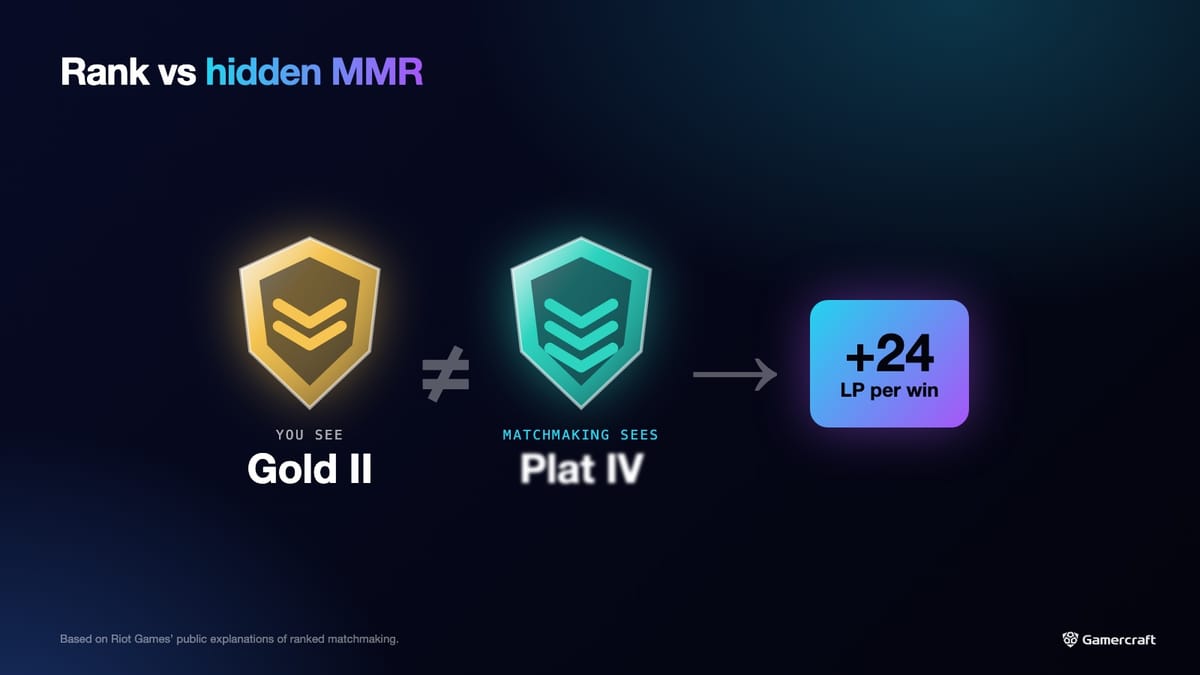
When your hidden MMR sits above your visible rank, wins pay more LP.
Every ranked game you play updates a rating behind the scenes. Beat players rated above you and it rises a lot; lose to players rated below you and it falls a lot. Matchmaking then looks for players with a similar rating. That rating is your MMR.
Your rank is a simpler, visible layer on top. Riot shows divisions and LP (League) or tiers and RR (Valorant) because they're easier to read and feel better to climb than a raw number. Over time the visible rank is pulled toward the MMR underneath it.
LP gains follow the gap. If your MMR is higher than your current rank, you gain more LP per win and lose less per loss. If it's lower, you gain less and lose more. Consistent +14 LP wins usually mean your MMR is below your rank.
Solo/Duo and Flex are separate. Each queue has its own MMR. A Diamond Flex rank tells you very little about Solo/Duo.
Normals have their own rating. Normal games use a separate matchmaking rating too. Good results there don't move your ranked MMR.
The season reset is soft. At the reset, your rank drops but your MMR mostly carries over, so strong players climb back quickly.
RR follows the gap. Same principle as LP. MMR above your rank means bigger RR gains; below it means smaller gains and bigger losses.
Performance counts in lower ranks. In Valorant's lower ranks, how well you personally played in a match also affects RR, not just the win or loss.
Double rank ups. When MMR is far above your rank, a single win can skip you past a tier. That's the system catching your rank up to your rating.
Placements use it. At the start of an act, your placement result is mostly derived from your MMR.
For the full Valorant tier list, see our guide to Valorant ranks in order.
Not exactly. Riot doesn't expose MMR through its public APIs, so every "MMR checker" is an estimate. Most of them look at the ranks of the players you were matched with and average them. That can give you a rough idea, but it's an educated guess, not your real number.
The most reliable signals are free and already in your client:
Your LP or RR per win versus per loss. Wins worth noticeably more than losses means your MMR is above your rank. The reverse means it's below.
The ranks in your lobbies. Regularly matched with and against players a division above you? Your MMR is probably there too.
Double rank ups or demotion shields. Both are signs the system thinks your rank and MMR are out of line.
Gamercraft runs skill-based ladders for League of Legends: four players join, each plays their normal ranked games, and each player's games are scored on their own performance from Riot's match data. Ladder lobbies aren't matched by rank, so a Silver player can share a ladder with a Diamond player.
That gives us an unusual data set. Since November 2025, players with a linked Solo/Duo rank have played more than 452,000 four-player LoL ladder entries. In a four-player ladder, a fair share of first places is 25%. Here's how often each rank actually finished first:
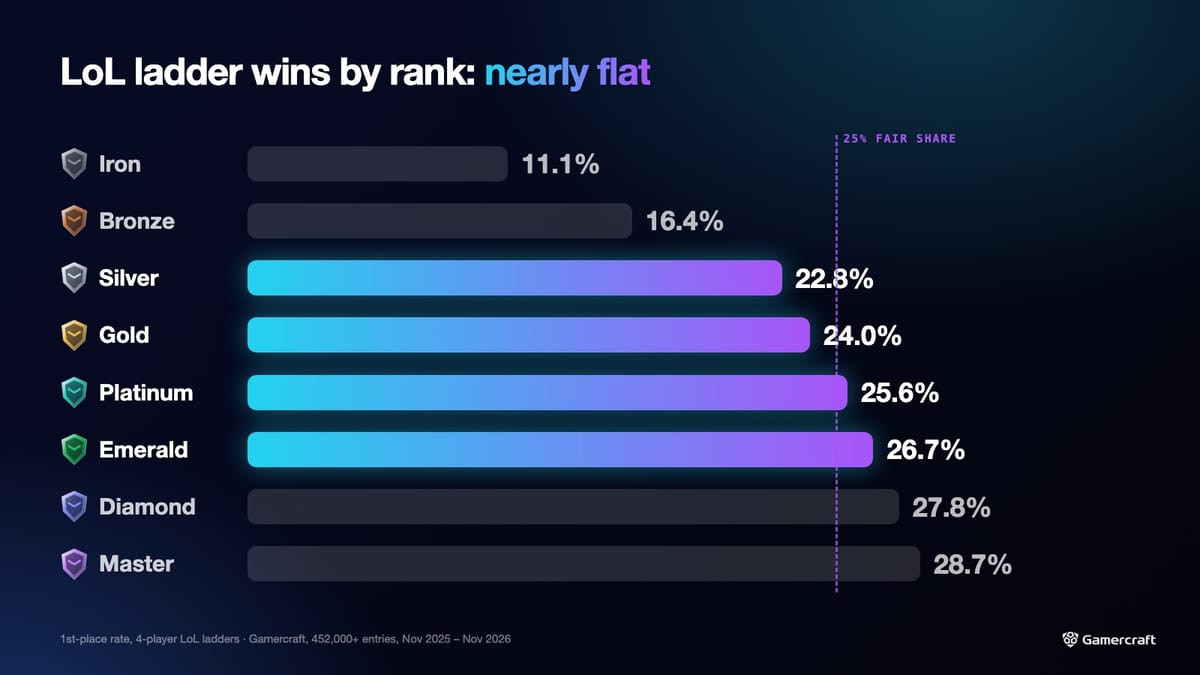
First-place rate by Solo/Duo rank. Source: Gamercraft ladder results, Nov 2025 – Nov 2026.
Solo/Duo rank | Ladder entries | Players | 1st place |
|---|---|---|---|
Iron | 3,191 | 129 | 11.1% |
Bronze | 21,276 | 587 | 16.4% |
Silver | 54,025 | 946 | 22.8% |
Gold | 72,517 | 1,185 | 24.0% |
Platinum | 84,237 | 1,071 | 25.6% |
Emerald | 105,445 | 771 | 26.7% |
Diamond | 56,810 | 388 | 27.8% |
Master | 54,510 | 168 | 28.7% |
From Silver to Emerald, rank moves the first-place rate by less than four points, all within a few points of a fair share. A Gold player and an Emerald player win a Gamercraft ladder at nearly the same rate. Rank only clearly matters at the edges: Iron and Bronze players win less often, and Master players a little more.
The reason is the same idea as MMR. Ranked matchmaking already puts you in games against players of your own skill. When you're scored on how you perform inside your own games, a Gold player having a great Gold game competes on equal terms with a Diamond player having an average Diamond game.
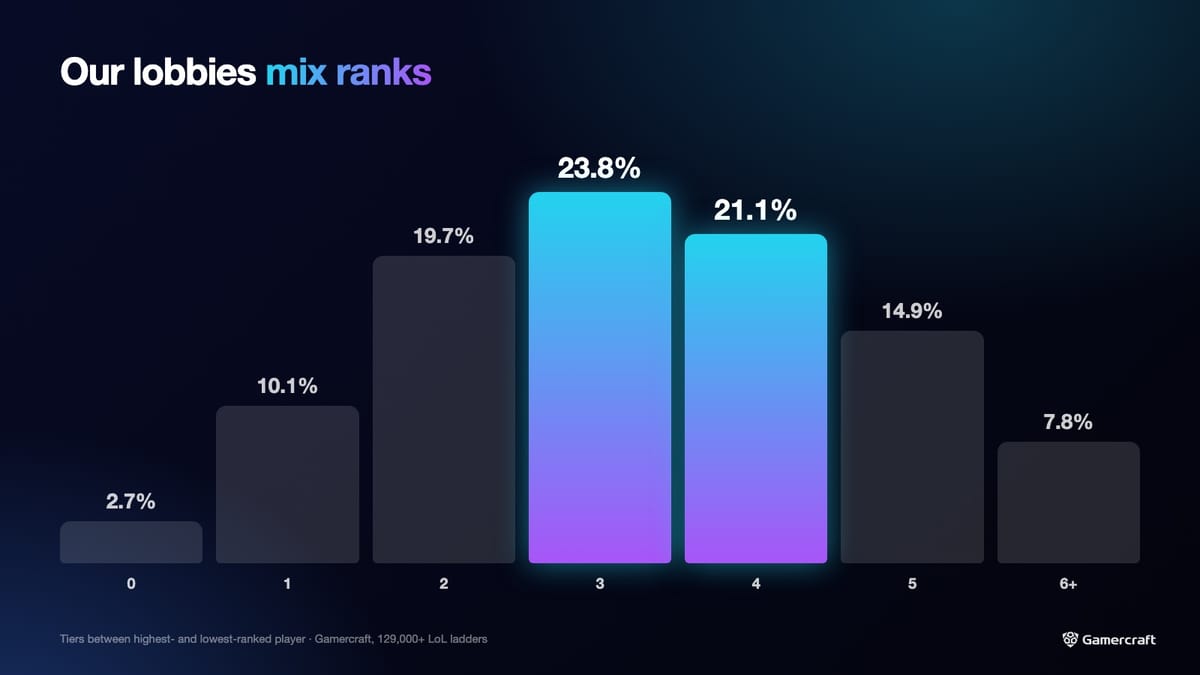
Ladders mix ranks on purpose: most have players three or four tiers apart. Source: Gamercraft ladder results, 129,000+ LoL ladders.
Win more than you lose over a long stretch. MMR is a long-run average. Ten games tell you very little; a hundred tell you a lot.
Stop dodging and remaking out of habit. Dodges cost LP without moving MMR the way you want, and leaving costs both.
Stick to one queue. Splitting time between Solo/Duo and Flex splits your progress too.
Play a small champion or agent pool. Consistent picks make your results consistent, and consistency is what moves MMR.
Don't chase a "reset". Making a new account to escape a low MMR rarely works and breaks Riot's rules if it's done to play below your level.
Want more League-specific advice? Read how to climb in League of Legends ranked.
If your games are going to count toward a hidden number anyway, they can count toward a ladder too. On Gamercraft you link your Riot account, play your normal ranked games, and compete in skill-based League of Legends tournaments scored on your own performance. As the data above shows, it isn't only for high ranks.
Hidden MMR is the matchmaking rating Riot uses to find opponents and teammates of similar skill. It's separate from your visible rank and isn't shown in the client.
Yes. Valorant uses a hidden MMR for matchmaking, and the gap between it and your visible rank changes how much RR you gain or lose.
Third-party sites offer estimates, but none can see your real MMR because Riot doesn't publish it. Comparing your LP per win and per loss is a more reliable signal.
Your hidden MMR is probably below your current rank. Keep winning and the gains rise as your MMR catches up.
Only slightly. Across 452,000+ entries, Silver to Emerald players took first place between 22.8% and 26.7% of the time, close to the 25% fair share in a four-player ladder.
Gamercraftのランク戦プレイヤー7,899人を調べたところ、最も多いソロ/デュオランクはゴールドで、ダイヤモンド以上はわずか10.4%。LoLランク分布の全データと、ランク別の賞金獲得実績を丸ごと公開します。
Quentin Rosso11月17日4分
ARAMスコアリングVersion 2では、各スタットを他の9人の最高値と比較。満点の100点は「10試合に1回」から「約36試合に1回」へと、ずっと出にくくなりました。
Quentin Rosso11月11日4分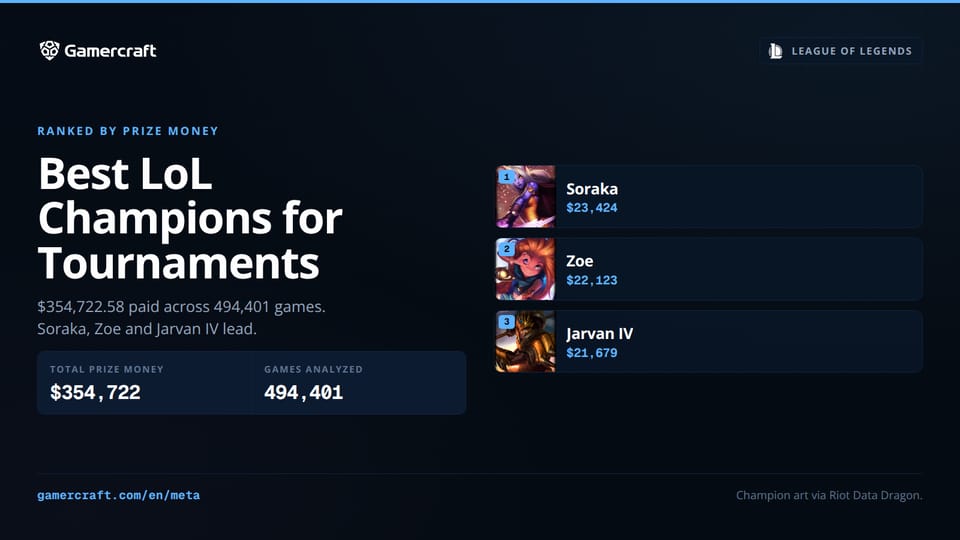
ソロキューのティアリストは勝率で並べる。私たちは全173体のチャンピオンを「実際に稼いだ賞金」で並べてみた。12か月・523,950試合にわたって支払われた総額は$380,308.98。トップ3はソラカ、ゾーイ、ジャーヴァンIVで、ADCの姿はひとつもない。
 Thomas Ruiz8月30日5分