Every League of Legends game you play in a Gamercraft ladder gets a score from 0 to 100, built from six parts read from Riot’s official match data. This post walks through what each part measures, how supports are scored differently, and one example game step by step. It covers Summoner’s Rift scoring 4.4, the current version.
The six parts
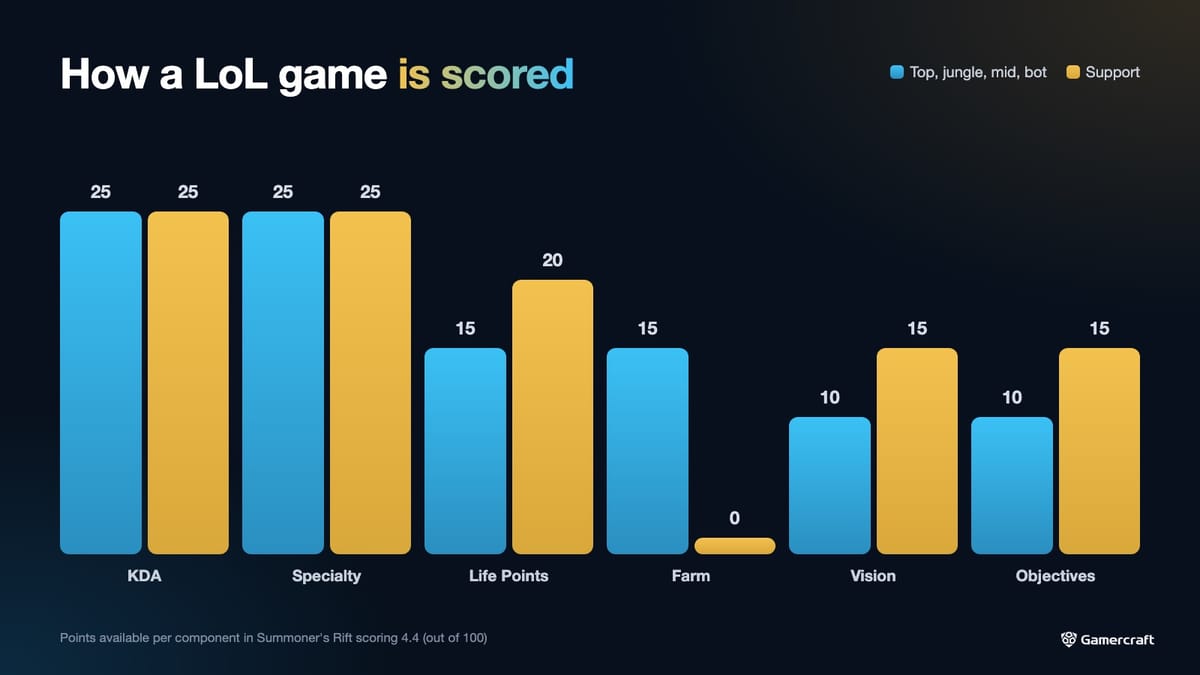
Points available per component in Summoner’s Rift scoring 4.4, out of 100.
| Part | What it measures | Top, jungle, mid, bot | Support |
|---|
| KDA | Kills, deaths and assists, and their impact on the game | 25 | 25 |
| Specialty | Your best of crowd control, duels, ganks, team fights and early domination | 25 | 25 |
| Life Points | Damage dealt, healing, shielding and tanking, and how and when you died | 15 | 20 |
| Farm | Minions and monsters, compared with the best non-support farmer in your game | 15 | 0 |
| Vision | Wards placed and cleared | 10 | 15 |
| Objectives | Towers, dragons, Baron and other objectives you helped take | 10 | 15 |
The 4.4 rule: compared with the best comparable player
For farm, you are compared with the best farmer among the non-supports in your game: match them for 95% of the points, lead them by 20% for full points, with the score climbing in a straight line between. Life Points and Vision count half as before and half against the best comparable player: Life Points against the best combined damage, healing, shielding and tanking, and Vision with supports compared against supports.
An example game, step by step
An illustrative mid laner, to show how the parts add up (rounded):
- KDA: 19 of 25. 7 kills, 3 deaths, 9 assists on a winning team.
- Specialty: 21 of 25. Their best category was team fights.
- Life Points: 11 of 15. High damage, one late death that cost points.
- Farm: 14.25 of 15. They matched the best non-support farmer in the game exactly, which is worth 95%.
- Vision: 6 of 10. Average warding for a mid laner.
- Objectives: 7 of 10. Helped take two dragons and a tower.
Total: about 78 of 100. Had they out-farmed the best farmer by 20%, Farm would have given the full 15.
Why the rules changed, and what we learned
Scoring is the part of Gamercraft we revisit most. In October 2026 we reviewed two weeks of ladder games and found that supports scored near the top of the vision scale in almost every game, because no other role wards as much, while bot laners had the lowest median score. Version 4.4 answered that by comparing like with like: supports’ vision against supports, farm only among non-supports. In ARAM we went the other way and made 100 harder to reach, because ladder players are usually the strongest player in their lobby. Each change was replayed on thousands of real games before it shipped. You can open the full breakdown of any scored game from the ladder page; for what counts as good, see the benchmarks by rank.
How we measured this
- Rules: Gamercraft Summoner’s Rift scoring 4.4 as shown in the in-app scoring explanation, November 2026.
- The example game is illustrative: it shows how the parts add up, not a specific player’s game.
- Other games (ARAM, TFT, Valorant, Brawl Stars) have their own scoring, explained on each ladder page.
FAQ
What is the Gamercraft score?
A score from 0 to 100 for each game, built from KDA, Specialty, Life Points, Farm, Vision and Objectives, read from Riot’s official match data.
How are supports scored?
Supports get no farm points. On 4.4, their Life Points are worth 20, Vision 15 and Objectives 15.
How do I get full farm points?
Out-farm the best non-support farmer in your game by 20%. Matching them gives 95%.
Where can I see my score breakdown?
Open any scored game from the ladder page to see each part.



 Quentin RossoNovember 263 min